Picking a mixer grinder in India should be easy. It is not. There is a row of similar products which claim to have the same copper engine, three jars, a long warranty, and an ISI mark. After an hour of reading their boxes, you get more perplexed than before entering the store. The buying choice depends either on price or which product the salesperson pointed at smilingly. After six months, you return to ask for the reason why your chutney jar started leaking.
Not all of the features listed in the box will cost extra. Some are indeed essential. Most of them are merely sticker labels meant to increase the price of the product.
Why Most Kitchens Settle On 750W
Motor power is the one choice you cannot fix later when buying a mixer grinder.
500W handles easy jobs. Tea masala. A quick coriander chutney. Thin batter for cheela. Put soaked rice and urad dal in it for dosa batter and you will hear the sound change inside the first minute. The motor strains. The body gets warm.
Something shifts at 750W. Idli batter comes out smooth in one pass. Whole garam masala grinds to a fine powder. Green chutney finishes while your tadka is still spluttering. This is where the mixer grinder starts matching the cooking.
The 1000W machines belong in tiffin kitchens and catering setups. For a regular flat in Mumbai or Chennai, 1000W just gives you a heavier unit and a bigger electricity bill.
Why Copper Beats Aluminium Inside The Motor
Here is one detail the salesman will quietly skip unless you ask. The wire wound inside that motor decides how many years your mixer grinder actually keeps running.
Copper takes heat better. During a long wet grinding session, copper windings resist burnout much better than aluminium ones. Brands put aluminium in cheaper units because it saves them money.
The gap stays invisible for the first two years. Year three is when things start happening. Aluminium units begin tripping, overheating, needing service visits. Copper units just carry on. Spend the extra 500 to 800 rupees when you buy.
Jars And What They Actually Do
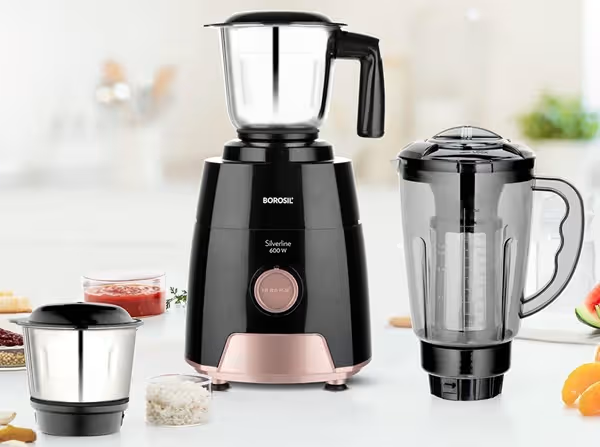
Three jars cover almost everything an Indian kitchen does. Here is the standard split:
| Jar Type | Capacity | Best Used For |
| Wet Grinding Jar | 1.5 L | Idli dosa batter, chutneys, curry pastes, lassi |
| Dry Grinding Jar | 1 L | Whole spices, coffee beans, dry masala powders |
| Chutney Jar | 400 ml | Small chutney, ginger garlic paste, tadka masala |
The number of jars matters less than what they are made of. Stainless steel. Nothing else.
Steel does not hold the smell of mustard tadka. Steel does not stain yellow from haldi. Steel does not crack when it slips out of soapy hands.
Plastic looks fine for six months. Then the smell starts. Within a year the plastic has yellowed in patches that no amount of scrubbing removes.
The Truth Behind The RPM Claims
Decent mixer grinder models sit between 18,000 and 22,000 RPM. That range covers Indian cooking well. Above it the motor runs hotter without producing a finer grind at home.
RPM on its own is useless. Without torque behind it, the blades slow down the moment the batter thickens. Trust the brand name and warranty length instead of the number on the box.
Safety Features Worth Checking
Overload protection will determine if your machine lasts three years or ten. It automatically turns off whenever the motor gets too hot or the blades get stuck. Stay away from a machine that doesn’t have overload protection.
Lid locking is another feature that’s crucial to consider. Push-on lids tend to come loose when the blade is spinning at high speeds. Only a screw type lid lock or dome lock works properly.
Rubber feet can also affect the performance of your machine. Machines without anti-skid feet tend to slide while grinding.
Warranty Tells You What The Brand Really Thinks
Two years on the product is the minimum. Five years on the motor is the number that actually means something.
Preethi, Philips, Havells, Bajaj. These brands offer long motor coverage because they expect their motors to last that long. A brand offering only one year total is telling you how long it expects its product to survive.
Service networks count just as much. A five-year warranty means nothing if the closest authorised centre is two cities away.
Conclusion
These are the five components of a mixer grinder that make the purchase worthwhile – the ones that will determine whether you keep your machine for ten years or discard it in three years’ time. These include a powerful 750 watt motor suited for Indian kitchens. Windings made of copper and not aluminum. The three required stainless steel jars in correct sizes. Overload protection and a foolproof lid locking system.