Choosing the right tyres is essential for motorcycle safety, riding comfort, and overall performance. When buying a new bike or replacing worn-out tyres, one common question is whether tubeless tyres or tube tyres are better. Both types are used on two-wheelers, but they differ in construction, puncture behaviour, maintenance, and repair requirements.
Tubeless tyres are increasingly popular on modern motorcycles because they can lose air more gradually after many small punctures. Tube tyres, on the other hand, use an inner tube to hold air and remain a practical option for bikes with compatible wheel designs.
So, which is better: tubeless tyres or tube tyres? For many everyday riders, tubeless tyres offer greater convenience and can be safer in certain puncture situations. However, tube tyres may be suitable for motorcycles designed specifically for them, including some models used on rough roads.
This guide explains the differences to help you choose the right option for your bike.
What Are Tubeless Tyres?
A tubeless tyre holds compressed air directly between the tyre and a compatible airtight wheel rim. It does not require a separate inner tube. An airtight seal between the tyre bead and the rim keeps the air inside.
Tubeless tyres are commonly fitted to modern motorcycles and scooters. They are particularly useful for everyday commuting because many small punctures can be repaired without removing an inner tube.
However, a tubeless tyre must be fitted to a compatible wheel. Not every traditional spoked wheel provides an airtight seal, although certain specially designed spoked wheels are compatible with tubeless tyres.
What Are Tube Tyres?
A tube tyre uses a separate rubber inner tube placed inside the tyre. The tube contains the air that supports the vehicle, while the outer tyre provides grip and protects the tube from road damage.
Tube tyres are commonly found on motorcycles with traditional spoked wheels, although the exact setup depends on the model.
If a sharp object punctures the tyre and inner tube, air may escape from the tube. Repair generally involves removing the wheel or tyre, inspecting the tube, and patching or replacing it as necessary.
Tube tyres remain useful, but repairs can take longer because the inner tube must be accessed.
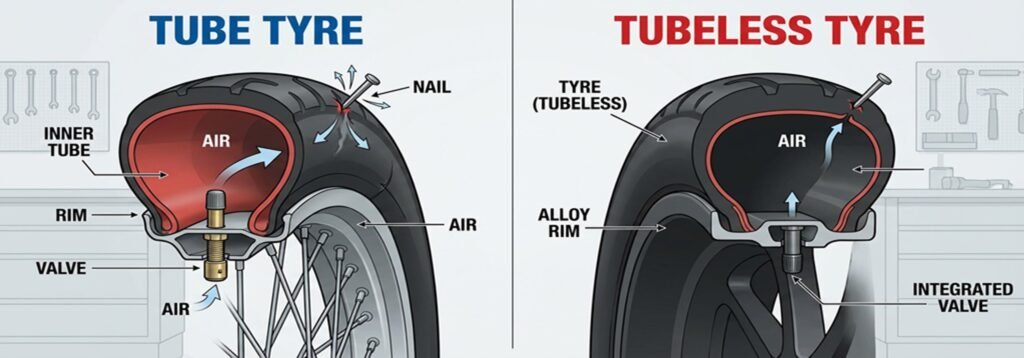
Tubeless Tyres vs Tube Tyres: Key Differences
| Feature | Tubeless tyres | Tube tyres |
| Construction | Air is held directly inside the tyre | Air is held in a separate inner tube |
| Puncture behaviour | Many small punctures cause gradual air loss | Tube punctures can cause faster air loss |
| Puncture repair | Often possible with a plug for suitable tread punctures | Usually requires access to the inner tube |
| Maintenance | No separate inner tube to inspect or replace | Inner tube may need patching or replacement |
| Wheel compatibility | Requires a compatible airtight rim | Suitable for compatible tube-type wheels |
| Repair convenience | Often easier for common small punctures | Can require more labour |
| Cost | Tyre and repair costs vary by model | Tube replacement adds a separate component cost |
The exact performance depends on tyre quality, wheel design, puncture location, and riding conditions.
Safety: Which Tyre Is Safer?
Safety is one of the most important factors when comparing tubeless and tube tyres. A tubeless tyre often has an advantage when a small nail or similar object penetrates the tread because air may escape relatively slowly. This can give the rider more time to recognise a problem and stop safely.
A tube tyre can lose air more quickly if the inner tube is punctured, potentially affecting stability and control. However, neither type is immune to sudden air loss, sidewall damage, valve failure, or other tyre problems.
Which is better? Tubeless tyres generally offer an advantage in managing many small punctures, but safe riding also depends on tyre condition, correct inflation, speed, and prompt attention to damage.
Never continue riding on a tyre that is losing pressure or appears damaged. Reduce speed carefully, move to a safe location, and arrange a repair.
Puncture Repair and Maintenance
Tubeless tyres are often easier to repair when the puncture is small and located in the tread. A suitable plug repair may be possible without removing the tyre from the wheel, depending on the damage and the manufacturer’s recommendations.
However, not every puncture can be repaired safely. Sidewall damage, large cuts, and damage near the tyre shoulder may require tyre replacement. A qualified technician should inspect the tyre before deciding whether a repair is appropriate.
Tube tyres generally require removing the tyre to access the inner tube. The tube can then be patched or replaced, depending on its condition. This process may take longer and require more labour.
Both types need regular pressure checks, tread inspections, and attention to cracks or uneven wear. Maintaining the correct tyre pressure improves handling, braking, and tyre life.
Cost: Which Is More Economical?
The total cost depends on the motorcycle, tyre size, brand, and local repair charges. Tubeless tyres may cost more than some comparable tube-type tyres, but they can offer savings in repair convenience and reduced downtime.
Tube tyres may be economical to repair when the damage is minor and the tube can be patched. However, repeated punctures, tube replacement, and labour can add to the overall cost.
When comparing prices, consider the complete tyre-and-wheel setup rather than looking at the tyre price alone. Always use a tyre type approved for your motorcycle.
Which Tyres Are Better for Indian Roads?
For many urban riders in India, tubeless tyres are a practical choice because roads may contain nails, glass, and other sharp debris. Their puncture-repair convenience can be especially useful for daily commuters.
Tube tyres remain suitable for motorcycles designed around tube-type wheels. Riders who frequently travel on rough roads should consider the complete wheel and tyre setup, durability, repair facilities, and manufacturer’s recommendations rather than assuming one tyre type is always superior.
Do not convert a tube-type wheel to tubeless unless the wheel is specifically designed or approved for that configuration.
Final Verdict
When comparing tubeless tyres vs tube tyres, tubeless tyres are generally the more convenient option for everyday commuting, particularly when easy puncture repairs are a priority. Tube tyres remain a suitable choice for motorcycles designed to use them.
Before making a change, check your motorcycle’s wheel compatibility, tyre specifications, and manufacturer’s recommendations. Whichever type you choose, maintain the correct air pressure, inspect tyres regularly, and repair damage promptly to help ensure safer riding.
Frequently Asked Questions
Q. Are tubeless tyres better than tube tyres for bikes?
For many everyday riders, tubeless tyres offer easier puncture repairs and can lose air more gradually after small tread punctures. However, the correct tyre type must match the motorcycle’s wheel design.
Q. Can a tubeless tyre be fitted to a tube-type wheel?
Not necessarily. The wheel must provide an airtight seal and be suitable for tubeless use. Consult the motorcycle manufacturer or a qualified tyre professional before changing the setup.
Q. Do tubeless tyres get punctures?
Yes. Tubeless tyres can be punctured by nails, sharp objects, and road debris. Their advantage is that some small punctures can be repaired conveniently without replacing an inner tube.
Q. Are tube tyres cheaper than tubeless tyres?
Some tube-type tyres are cheaper to purchase, but total costs depend on the model, inner tube, labour, and frequency of repairs.
Q. Can I ride with a nail in a tubeless tyre?
Avoid continuing to ride unnecessarily. The tyre may be losing air or have internal damage. Stop somewhere safe and have a professional inspect it.