Choosing between a motorcycle and a scooty can be challenging, especially if you are buying your first two-wheeler. Both offer convenient transportation, help reduce dependence on public transport, and make daily travel easier. However, they differ in riding comfort, fuel efficiency, storage, performance, maintenance, and overall suitability for different riders.
In India, motorcycles are popular among commuters, long-distance riders, and people who prefer a traditional geared riding experience. Scooties, commonly called scooters, are often preferred for city travel because they are easy to operate, convenient for short trips, and practical for everyday errands.
So, which is better: a motorcycle or a scooty? The right choice depends on your daily travel distance, budget, road conditions, riding experience, and personal preferences. This guide compares both options to help you make an informed decision.
What Is the Difference Between a Motorcycle and a Scooty?
A motorcycle typically has a larger frame, a fuel tank positioned between the rider’s knees, and a seat designed for a motorcycle-style riding position. Most conventional petrol motorcycles use manual gears and a clutch, although automatic and electric motorcycle options are also available.
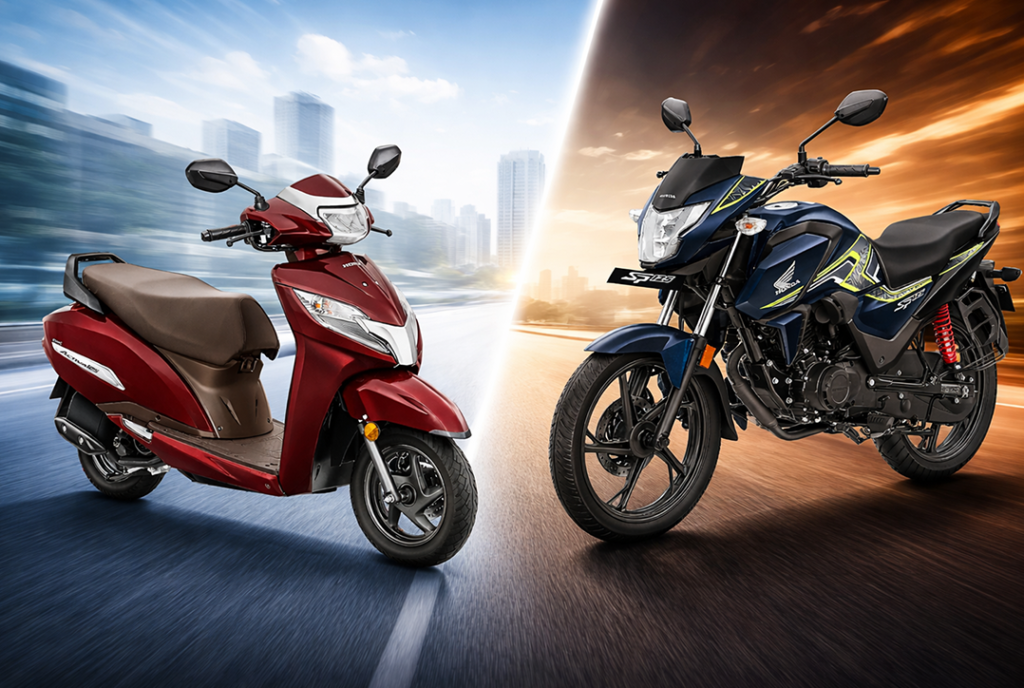
A scooty is generally a lightweight scooter with a step-through design, an upright seating position, and an automatic transmission. Many scooters provide under-seat storage and a flat floorboard or footwell, making them convenient for carrying everyday items.
Although both vehicles serve similar transportation needs, their design makes them suitable for different riding situations.
Motorcycle vs Scooty: Key Differences
| Feature | Motorcycle | Scooty |
| Riding style | Usually geared, with manual clutch operation | Usually automatic and easier to operate |
| City traffic | Suitable, but gear changes may require more effort | Convenient for frequent stops and starts |
| Fuel efficiency | Depends on engine size and riding style | Often economical, depending on the model |
| Storage | Usually limited | Commonly offers under-seat storage |
| Long-distance riding | Many models suit highway travel | Suitable for shorter trips and some longer journeys |
| Learning experience | Requires learning clutch and gear control on most models | Generally easier for beginners |
| Passenger comfort | Depends on seat design and suspension | Often convenient for everyday two-person trips |
| Performance | Broad range, including powerful models | Usually focused on commuting and practical mobility |
These are general differences. Individual models can vary significantly in performance, comfort, mileage, and features.
Riding Comfort and Ease of Use
A scooty is often easier to ride in crowded urban areas because most petrol scooters use automatic transmission. Riders do not need to operate a clutch or change gears manually, which can make frequent stops and starts less tiring.
The upright seating position and step-through design can also make mounting and dismounting convenient. Under-seat storage provides space for items such as a helmet, rainwear, or small shopping bags, depending on the scooter’s design.
Motorcycles can also be comfortable, but their riding position varies. Commuter motorcycles generally offer a practical seating position, while sportier models may require riders to lean forward. Some motorcycles are heavier than scooters, which can make low-speed manoeuvring more difficult for inexperienced riders.
Which is better? A scooty is often more convenient for short urban trips, while the best option for overall comfort depends on seat design, suspension, vehicle weight, and rider height.
Mileage and Fuel Expenses
Fuel efficiency is an important consideration for anyone who travels regularly. Both motorcycles and scooters are available in fuel-efficient models, but actual mileage depends on engine capacity, traffic, riding habits, tyre pressure, maintenance, and load.
Small-engine commuter motorcycles can deliver excellent fuel efficiency, making them attractive to people who cover long distances every day. Scooters can also offer good mileage and may be economical for routine city commuting.
Before purchasing, compare the manufacturer’s claimed fuel efficiency with credible real-world user reports. Avoid assuming that every motorcycle delivers better mileage than every scooter, or vice versa.
You can estimate monthly fuel expenses using this formula:
Monthly fuel cost = Monthly distance ÷ Actual mileage × Petrol price per litre
For example, if you travel 600 kilometres per month, your vehicle delivers 45 kilometres per litre, and petrol costs ₹100 per litre, your estimated monthly fuel expense is approximately ₹1,333.
This is an illustration, not a guaranteed mileage figure. Use the actual efficiency and local petrol price for a more accurate estimate.
Price and Maintenance Costs
The purchase price of a motorcycle or scooty depends on the brand, engine capacity, features, and model. Both categories include affordable entry-level options as well as premium vehicles.
Scooters may be attractive to buyers who want convenience without paying for features they do not need. Motorcycles offer a wide range of choices, from basic commuter models to touring and performance-oriented bikes.
Maintenance costs also vary. Motorcycles may require periodic chain cleaning, lubrication, and adjustment, while scooters with enclosed transmission systems have different servicing requirements. Both generally need regular tyre checks, brake inspections, engine oil changes where applicable, and scheduled servicing.
When comparing the total cost, consider insurance, fuel, servicing, replacement parts, and resale value rather than focusing only on the initial price.
Performance and Long-Distance Riding
Motorcycles generally provide more variety in engine capacity, power delivery, and highway-oriented features. This makes them suitable for riders who regularly travel between cities or want a vehicle for longer weekend journeys.
Many commuter motorcycles offer stable handling and comfortable seating for extended rides. Larger motorcycles may also provide better options for touring, although comfort depends on the specific model.
Scooters are excellent for everyday mobility, but smaller-engine models may feel less comfortable when travelling at sustained highway speeds. Their smaller wheels, suspension setup, and performance characteristics vary by model, so buyers should check the manufacturer’s intended usage.
Which is better? A motorcycle is usually the more versatile choice for frequent long-distance travel, while a scooty is often more practical for everyday urban journeys.
Storage and Everyday Practicality
Storage is one of the most noticeable advantages of a scooty. Many scooters include under-seat compartments and front storage areas, making it easier to carry groceries, a small backpack, or other everyday essentials.
Motorcycles typically have limited built-in storage. Riders may need to purchase a tank bag, backpack, or luggage carrier for additional space.
Scooters can also be convenient for errands because their design makes it easier to get on and off frequently. However, storage capacity differs between models, and a helmet may not fit in every scooter’s under-seat compartment.
If you regularly carry shopping bags or small personal items, a scooty may offer greater convenience.
Safety and Handling
Safety depends more on responsible riding, vehicle condition, protective equipment, and road conditions than on whether you choose a motorcycle or a scooty.
Motorcycles and scooters can both be suitable for everyday travel when ridden correctly. Before buying, check braking performance, tyre quality, lighting, stability, and whether the vehicle has features such as an anti-lock braking system (ABS) or a combined braking system (CBS), as applicable.
Beginners should choose a vehicle they can comfortably balance, manoeuvre, and stop. Always wear a properly fitted helmet, follow traffic rules, and maintain a safe distance from other vehicles.
Neither category is automatically safer in every situation. Take a test ride, where permitted, and assess how confidently you can control the vehicle.
Which Is Better for Different Riders?
A scooty may be the better choice if you:
- Primarily travel short distances within a city.
- Frequently encounter stop-and-go traffic.
- Prefer automatic transmission and simple controls.
- Need convenient storage for everyday belongings.
- Want an easy-to-use vehicle for routine errands.
A motorcycle may be the better choice if you:
- Regularly commute longer distances.
- Frequently travel on highways or between cities.
- Prefer manual gears and clutch control.
- Want a broader selection of performance-oriented models.
- Need a vehicle suited to your preferred riding style.
Your height, physical comfort, parking arrangements, budget, and local road conditions should also influence your decision.
Final Verdict
When comparing a motorcycle vs scooty, a scooty is often better for convenient city commuting, while a motorcycle is generally better for longer journeys and a wider range of riding needs.
If you mainly travel through crowded streets, need storage, and prefer simple controls, a scooty may suit you better. If you commute over longer distances, travel on highways, or enjoy a geared riding experience, consider a motorcycle.
Ultimately, compare specific models for price, mileage, comfort, maintenance, and safety features. The best two-wheeler is the one that fits your everyday requirements, budget, and riding experience.
Frequently Asked Questions
Q. Which is better for daily use, a motorcycle or a scooty?
A scooty is often more convenient for short city trips and crowded traffic. A motorcycle may be preferable for longer commutes or riders who prioritise highway capability.
Q. Which gives better mileage, a motorcycle or a scooty?
Mileage depends on the specific model, engine size, traffic, and riding habits. Compare real-world fuel efficiency rather than assuming one category is always more economical.
Q. Is a scooty better for beginners?
Many beginners find scooters easier to operate because most petrol models use automatic transmission. However, safe riding still requires practice, balance, and knowledge of traffic rules.
Q. Which is cheaper to maintain?
Neither is universally cheaper. Servicing requirements, replacement parts, tyre costs, and model complexity determine maintenance expenses.
Q. Which is better for long-distance travel?
Motorcycles are generally more suitable for frequent long-distance and highway journeys, although some scooters can handle longer trips when their specifications and intended use permit.