Choosing between an air-cooled and a liquid-cooled engine is an important consideration when buying a motorcycle or scooter. The engine cooling system affects operating temperature, maintenance requirements, performance consistency, weight, and overall ownership costs. Both technologies are widely used in two-wheelers, but each is suited to different riding needs.
Air-cooled engines are commonly found in commuter motorcycles because they have a relatively simple construction and generally cost less to maintain. Liquid-cooled engines are often used in performance-oriented motorcycles because they provide more precise temperature control, particularly under demanding riding conditions.
So, which is better: an air-cooled or liquid-cooled engine? An air-cooled engine may be ideal for everyday commuting and budget-conscious ownership, while a liquid-cooled engine can be a better choice for sustained high-speed riding, heavy traffic, and performance-focused use. The right option depends on your budget, riding habits, climate, and the motorcycle you intend to buy.
What Is an Air-Cooled Engine?
An air-cooled engine uses airflow to remove heat generated during combustion. Many air-cooled motorcycle engines have cooling fins on the cylinder and cylinder head. These fins increase the surface area exposed to the surrounding air, allowing heat to escape more effectively.
Some motorcycles also use forced-air cooling arrangements, depending on their design. However, conventional air-cooled two-wheeler engines primarily rely on airflow created by vehicle movement and natural air circulation.
Because these engines do not require a separate liquid-cooling circuit, they generally have fewer cooling-system components. This can simplify construction and reduce the number of parts that require servicing.
Air-cooled engines are common in commuter motorcycles, where simplicity, affordability, and practical everyday performance are important.
What Is a Liquid-Cooled Engine?
A liquid-cooled engine circulates coolant through passages around the engine to absorb heat. The heated coolant then travels to a radiator, where airflow helps release the heat into the surrounding environment. A water pump circulates the coolant, while a thermostat and other components help regulate operating temperature.
Despite the common term “water-cooled,” many motorcycle systems use a specially formulated coolant rather than plain water.
Liquid cooling allows the engine to maintain a more controlled operating temperature across different riding conditions. This can be particularly useful for motorcycles that produce substantial power or operate under sustained loads.
Liquid-cooled engines are common in sports bikes, touring motorcycles, and many modern performance-oriented models.
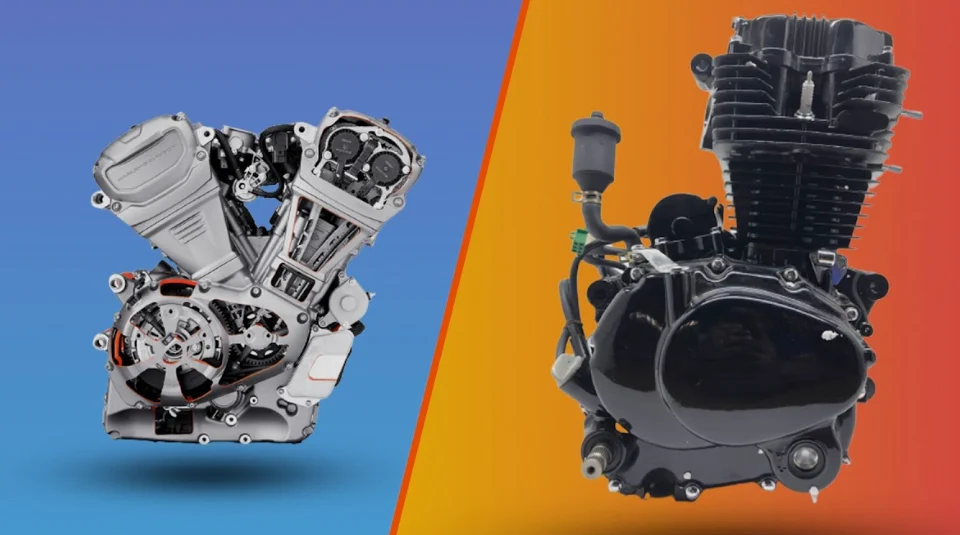
Air-Cooled vs Liquid-Cooled Engine: Key Differences
| Feature | Air-cooled engine | Liquid-cooled engine |
| Cooling method | Uses airflow and cooling fins | Circulates coolant through a radiator |
| Construction | Generally simpler | More complex |
| Initial cost | Often lower | Often higher |
| Maintenance | Usually fewer cooling-system components | Requires coolant and cooling-system maintenance |
| Temperature control | More affected by airflow and operating conditions | Generally more consistent |
| Performance suitability | Well suited to many commuter applications | Often preferred for sustained high-performance use |
| Weight and packaging | Often lighter and simpler | Adds components such as a radiator and coolant |
| Potential repairs | Cooling system is relatively straightforward | More components can require inspection or repair |
These are general differences. Actual performance, cost, and reliability depend on the specific engine and its design.
Performance and Temperature Control
Liquid-cooled engines generally have an advantage when consistent engine temperature is important. The radiator, coolant pump, and thermostat help regulate heat even when the motorcycle is working hard or moving slowly through traffic.
This temperature control allows manufacturers to design engines for higher power output and sustained performance when appropriate. Liquid cooling can also help reduce some engine noise because the coolant jacket dampens mechanical sound.
Air-cooled engines can still deliver dependable performance when designed for their intended use. For small-capacity commuter motorcycles, they can provide sufficient power without the added complexity of a radiator and coolant circuit.
Which is better? Liquid cooling is generally preferable for high-performance riding and sustained heavy loads. Air cooling is often sufficient for everyday commuting.
Maintenance and Repair Costs
Air-cooled engines generally have simpler cooling arrangements because they do not need a radiator, coolant pump, hoses, or a separate coolant circuit. This can reduce cooling-system maintenance and simplify certain repairs.
Liquid-cooled engines require periodic coolant inspections and replacement according to the manufacturer’s service schedule. Radiators, hoses, fans, pumps, and seals also need attention. A leak or cooling-system failure can cause overheating and potentially serious engine damage if ignored.
However, a simpler cooling system does not automatically mean lower total maintenance costs. Servicing expenses also depend on engine design, spare-part prices, reliability, and how the motorcycle is used.
Which Engine Is Better for Indian Weather and Traffic?
Indian riding conditions can include high summer temperatures, congested city roads, and long highway journeys. The best cooling system depends on the demands placed on the engine.
Air-cooled engines can work well in Indian conditions when properly designed and maintained. However, prolonged idling and slow-moving traffic reduce airflow around the engine, potentially increasing operating temperatures.
Liquid-cooled engines can manage temperature more consistently in stop-and-go traffic because a radiator fan can provide airflow even when the motorcycle is moving slowly. This can be beneficial during hot weather and demanding rides.
Neither system makes a motorcycle immune to overheating. Follow the manufacturer’s operating recommendations and never ignore an overheating warning.
Which Cooling System Should You Choose?
Choose an air-cooled motorcycle if you:
- Primarily commute to work, college, or nearby locations.
- Want a relatively simple engine design.
- Prefer potentially lower purchase and maintenance costs.
- Do not regularly ride at high speeds for extended periods.
Choose a liquid-cooled motorcycle if you:
- Frequently take long highway trips.
- Want a performance-oriented motorcycle.
- Regularly ride under demanding conditions.
- Prefer more consistent engine-temperature control.
Final Verdict
In the air-cooled vs liquid-cooled engine comparison, liquid cooling is generally better for temperature control and sustained performance, while air cooling is often better for simplicity and budget-conscious ownership.
If you mainly ride short distances and want a straightforward commuter motorcycle, an air-cooled engine may be all you need. If you frequently travel long distances or prefer a high-performance bike, liquid cooling can offer meaningful advantages.
Before purchasing, compare the complete motorcycle rather than focusing on its cooling system alone. Engine reliability, fuel efficiency, comfort, service costs, and your riding habits all matter when choosing the right two-wheeler.
Frequently Asked Questions
Q. Which is better, an air-cooled or liquid-cooled engine?
Liquid cooling generally offers better temperature control under demanding conditions. Air cooling is often sufficient for everyday commuting and offers a simpler design.
Q. Does a liquid-cooled engine give better mileage?
Not necessarily. Fuel economy depends on engine design, tuning, riding style, vehicle weight, and traffic conditions. Liquid cooling can help maintain consistent operating conditions, but it does not guarantee better mileage.
Q. Are air-cooled engines reliable?
Yes. A properly designed and maintained air-cooled engine can be reliable for many years. Correct engine-oil levels, regular servicing, and sensible riding habits remain important.
Q. Is liquid cooling worth the extra cost?
It can be worthwhile if you need sustained performance, frequently travel long distances, or ride in demanding conditions. For ordinary commuting, an air-cooled engine may be sufficient.
Q. Can a liquid-cooled motorcycle overheat?
Yes. Coolant leaks, a faulty fan, a damaged radiator, or pump problems can cause overheating. Stop safely and arrange an inspection if the engine overheats.


